
Why Are Lithium Stocks Moving?
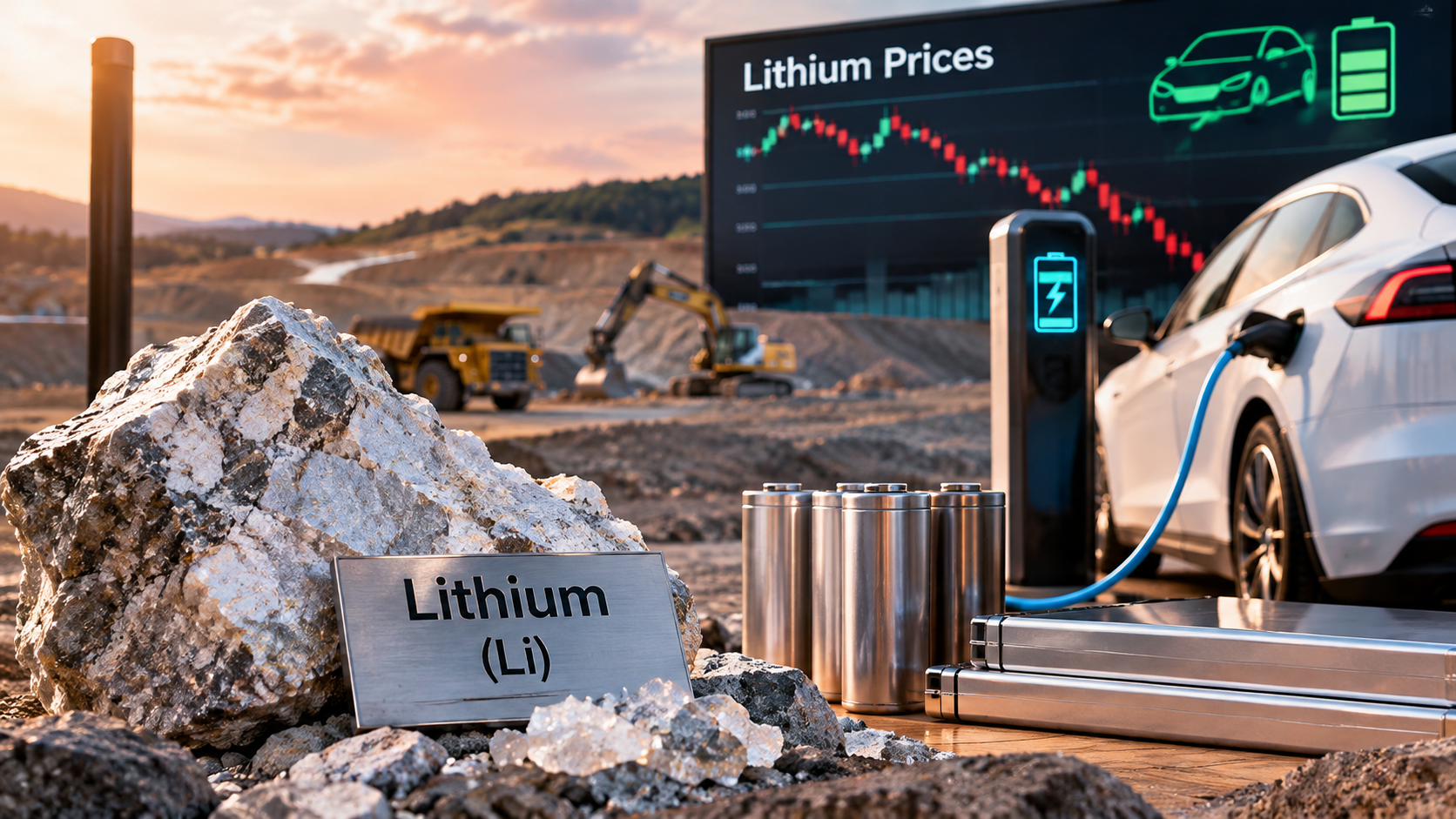
In the global battery materials market, lithium stocks have seen big price swings in 2026 amid swirling expectations. Lithium prices, which rebounded strongly in the first half of the year, are under renewed pressure as worries about future demand along with rising supply and inventory levels weigh on investor sentiment.
These are developments of particular interest to investors watching the Australian share market. Australia is a major producer of lithium and changes in global lithium prices can impact the earnings outlook, project valuations and share prices of local mining companies. Knowing what’s behind these moves might be able to explain why lithium stocks tend to move sharply even when individual companies haven’t made any major announcements.
1. Changes in Global Lithium Prices
One of the biggest factors for lithium stocks is the price of lithium. Fluctuations in the prices that mining companies receive for their spodumene or other lithium products affect them. Higher prices can enhance expected revenue and profit margins. With falling prices, investors may reassess their expectations of future profits and the value of projects already underway.
Lithium prices rebounded strongly in the first half of 2026, driven by supply disruptions in China and Zimbabwe, and demand from the battery supply chain. But since then the recovery has stalled. The Australian September 2026 Resources and Energy Quarterly reported spodumene prices more than trebled and lithium hydroxide prices more than doubled on the same period in 2025. Prices are expected to stay high in the short term before easing from 2027.
More recently, weaker market sentiment and concerns about additional supply have renewed price pressure. This has impacted expectations for producers, especially those with higher operating costs or projects that require a large amount of investment.
2. Electric Vehicle Demand Remains Important
Lithium demand is still largely driven by electric vehicles (EVs). Lithium is a key element in rechargeable batteries for electric vehicles and battery makers’ demand for material can be affected by changes in vehicle production and sales.
As EV sales and battery production rise, the demand for lithium could go up. But weaker vehicle sales, changes in government incentives or weaker consumer spending could impact battery orders and weigh on expectations for lithium consumption.
China is particularly important because of its influence across the global EV and battery supply chain. Recent fears of a slowdown in the Chinese EV market have added to uncertainty about future lithium demand. Citi cut its lithium price forecasts in early November, citing slower battery demand growth, trade uncertainty and wider economic concerns.
Investors thus track EV sales, battery production forecasts and policy changes in major markets to gauge the likely direction of lithium demand.
3. Growth in Battery Energy Storage Systems
Lithium is not just in demand for electric vehicles. Countries are boosting renewable electricity generation and investing in electricity storage. Therefore, battery energy storage systems (BESS) are an increasingly important part of the market.
These systems use big batteries to store electricity generated from solar and wind power, among other sources. This enables energy to be fed when renewable generation is lower or electricity demand is increasing.
Lithium demand has also been fueled by the growth of energy storage projects. Australia’s resources outlook for September 2026 expects global demand for lithium to grow by more than 11% a year to 2031, supported by the adoption of EVs and the deployment of battery energy storage.
But the pace of growth matters too. The growth of China’s energy storage battery demand is expected to slow in 2027 compared with the rapid expansion seen in 2026, market participants expect, S&P Global said in October. This has cast doubt on the pace at which additional lithium supply will be absorbed by demand in the future.
4. Supply Levels and Production Decisions
The volume of material available in the market also has a big impact on lithium prices. If production outpaces demand, inventories can build and prices can come under pressure. In contrast, mine closures, production delays or export restrictions can tighten supply and prop up prices.
The earlier recovery in lithium prices was also aided by recent supply disruptions in China and Zimbabwe. But investors are worried about expectations of more production. Some Australian operations have also been returning or expanding production, adding to expectations of more supply.
The Australian Government expects lithium mine production in Australia will increase by around 8.8% per year to 2031. Global supply is expected to increase by some 7.3% per annum over the same period, although the market is expected to remain oversupplied in the near term before moving towards balance later in the outlook period.
These projections underscore the importance of production discipline. If supply grows too fast, even strong long-term demand may not be enough to ward off short-term price weakness.
5. Inventory Levels and Market Sentiment
Inventory levels can be a good indicator of the supply-demand balance of lithium. Inventories rising may suggest that production is ahead of current consumption, while inventories falling may indicate tighter market conditions.
Recent uncertainty over Chinese inventories of battery materials has been a factor affecting lithium prices. Inventory estimates have changed and worries about slower battery production have added to market volatility. Lithium carbonate prices in China have dropped below CNY 95,000 per ton in November, the lowest in almost a year, as concerns about softer demand and better supply emerged.
Market sentiment can also magnify these movements. Investors may buy lithium stocks if they expect a rebound in lithium prices. Conversely, fears of an oversupply in the future trigger selling. So share prices can be affected by futures trading, analyst forecasts and the wider market situation even before any change can be seen in the company’s earnings.
6. How Lithium Price Movements Affect ASX Stocks
Australian lithium stocks are very reactive to moves in commodity prices as their valuations are closely linked to expected production, sales prices and operating costs.
Established producers may benefit from higher lithium prices as they increase revenues and margins. Companies with higher production costs may experience greater pressure when prices fall. Exploration and development companies can be even more sensitive, as their valuations are often based on assumptions about future production, availability of funding and project economics.
In general, the sector investors look at companies such as Pilbara Minerals, Liontown Resources and Mineral Resources. Their share price reaction to wider lithium market trends may be affected by their production performance, operating costs, project developments and financial position.
Importantly, not all lithium stocks react the same. A company with production already in place and a strong balance sheet may be better positioned to ride out weaker prices than a developer that requires additional capital to advance its projects.
7. What Investors Should Watch Next
The movement of lithium stocks will be dictated by supply and demand in the coming months. Investors should watch Chinese lithium prices, EV sales, battery production, energy storage demand and inventory moves. Changes in mine production and government policies affecting lithium exports can also affect market conditions.
Company-specific factors are as important. Valuations can be affected by production guidance, cash costs, capital expenditures, project development timelines and funding requirements. A rebound in lithium prices may lift the sector as a whole, but individual companies will still need to prove they can run efficiently and meet their financial obligations.
Risk Considerations
Lithium stocks are volatile, too. Their valuations are subject to commodity prices, supply and demand factors, and investor sentiment changes. Higher global production, weaker battery demand or delays in EV uptake could put more pressure on lithium prices. Companies may also be confronted with rising operating costs, project delays, funding constraints and regulatory changes. Investors should consider these risks in the light of each company’s financial position, production forecast and longer-term project outlook.
Disclaimer:
General Financial Product Advice and Regulatory Framework: Pristine Gaze Pty Ltd (ABN 66 680 815 678, ACN 680 815 678) operates as Corporate Authorised Representative (CAR No. 001312049) of Alpha Securities Pty Ltd (AFSL 330757), which is licensed and regulated by the Australian Securities and Investments Commission under the Corporations Act 2001 (Cth). This report contains general financial product advice only and has been prepared without consideration of your personal objectives, financial situation, specific needs, circumstances, or investment experience. The information is not tailored to individual circumstances and may not be suitable for your particular situation. Before acting on any information contained herein, you should carefully consider its appropriateness having regard to your personal objectives, financial situation, and needs, and consider seeking personal financial advice from a qualified financial adviser who can assess your individual circumstances and provide tailored recommendations.
Investment Risks and Market Warnings: All investments carry significant risk, and different investment strategies may carry varying levels of risk exposure including total loss of invested capital. The value of investments and income derived from them can fluctuate significantly due to market conditions, economic factors, company-specific events, regulatory changes, commodity price volatility, currency fluctuations, interest rate movements, and other factors beyond our control. Securities markets are subject to market risk from general economic conditions and investor sentiment, liquidity risk affecting the ability to buy or sell securities at desired prices, credit risk from issuer default or deterioration, operational risk from inadequate internal processes, sector-specific risks including industry regulatory changes, technology obsolescence, management changes, competitive pressures, supply chain disruptions, and mining-specific risks including resource estimation uncertainty, operational hazards, environmental compliance, permitting delays, commodity price cycles, geopolitical factors affecting mining operations, and exploration risks. Small-cap and speculative mining stocks carry additional risks including limited liquidity, higher volatility, dependence on key personnel, limited operating history, uncertain cash flows, and potential failure to achieve commercial production.
Information Accuracy and Limitations: While we endeavour to ensure information accuracy and reliability, we make no representations or warranties (express or implied) regarding the accuracy, reliability, completeness, timeliness, or suitability of information provided, except where liability cannot be excluded under applicable law. This report may include information from third-party sources including company announcements, regulatory filings, research reports, market data providers, financial news services, and publicly available information, which we do not independently verify and for which we assume no responsibility. Past performance, examples, historical data, or projections are not indicative of future results, and no guarantee of future returns is provided or implied. To the maximum extent permitted by law, Pristine Gaze Pty Ltd and Alpha Securities Pty Ltd, together with their respective directors, officers, employees, representatives, and related entities, exclude all liability for any errors, omissions, inaccuracies, loss or damage (including direct, indirect, consequential, or special damages) arising from reliance on information provided, investment decisions made based on this report, market losses, opportunity costs, and technical issues or system failures.
Frequently Asked Questions
Common questions about investing and market research to help guide your decisions.