Penny Stocks and Market Capitalisation: A Beginner's Guide

A penny stock is popular with inexperienced investors because of low share prices and potential for large percentage gains. Usually, such stocks are associated with small companies, developing businesses or companies involved in nascent industries. But a low share price doesn't necessarily mean that a company is undervalued or a good investment opportunity.
Another important factor to understand about penny stocks is their market capitalisation. This gives a more accurate picture of a company’s overall market value and can help investors tell the difference between smaller businesses and larger, established companies. Knowing the link between penny stocks and market cap can help a beginner make better investment decisions and avoid common pitfalls.
What Are Penny Stocks?
Penny stocks are stocks of small or emerging companies that are traded at relatively low prices. In Australia the term is often used to refer to cheaper shares listed on the Australian Securities Exchange (ASX), but there is no single universal definition of what a penny stock is.
These companies could be in fields like mining, biotechnology, technology and renewable energy. Some are still developing their products, exploring resources or approaching commercial production. Therefore, their financial track record and future outlook may be less clear than larger companies.
A small movement in the price of a penny stock can represent a large percentage change, which may attract investors. But they can also see sharp drops, limited trading activity and more uncertainty. A low share price, therefore, is no proof a stock is cheap.
What Is Market Capitalisation?
Market capitalisation, or market cap, is the total dollar market value of a company’s outstanding shares. It is calculated by multiplying the total number of outstanding shares by the current share price.
Market Capitalisation = Current Share Price x Total Number of Shares Outstanding
Let's say, for example, that a company has 200 million shares outstanding and a share price of $0.20. It would have a market capitalisation of $40 million.
If another company has a share price of $2.00 but only 10 million shares, its market capitalisation would be $20 million. The share price is higher, but the market value is lower.
This example shows why investors should not judge a company by its share price alone. Market capitalisation is a more useful starting point for measuring the size of a business and comparing it with other quoted companies.
Why Market Cap Matters When Assessing Penny Stocks
Market capitalisation helps investors to get a feel for the size of a company and the level of risk that may be attached to its shares. Many penny stocks have relatively small market caps, making them more sensitive to changes in business performance, funding conditions and investor sentiment.
Smaller companies may have limited revenues from operations, limited financial resources, and greater reliance on external financing. They may also be more sensitive to delays in the development of a project or changes in market conditions.
Market cap can also help investors compare businesses in the same industry. For example, two mining companies may have shares priced at similar levels but their market capitalisations may differ significantly due to differences in their share counts, assets, production prospects and financial positions.
But market capitalisation doesn’t tell you everything about a company. Investors should also look at its debt, cash reserves, revenue, earnings, operating costs and future funding needs.
Different Market Capitalisation Categories
Public companies are often classified by market capitalisation. Different markets and financial institutions may use different specific thresholds, but the following are typical categories.
Small-cap stocks: These are companies with relatively small market values, and they may be in the early stages of expansion. They can bring growth, but may have more financial and operational uncertainty.
Mid-cap stocks: These companies are typically more established than small-cap companies. They may have a larger customer base, stronger sources of income, and more developed operations.
Large-cap stocks: These are companies with large market values, established operations and greater access to capital. Their shares may be easier to buy and sell, but they are still subject to market or business risk.
You’ll often see penny stocks lumped in with small caps, but they’re not synonymous. If a company has a high number of shares outstanding, it can have a low share price and relatively large market capitalisation. Similarly, a small-cap company might be trading at a share price well above what investors typically think of as penny stocks.
Key Factors to Consider Before Investing
Beginners should not only consider the share price and market capitalisation before investing in penny stocks. There are also a number of other factors that can help provide a more complete picture of a company’s financial position and prospects.
1. Financial Performance
Look at the revenue, earnings, cash flow and balance sheet of the company. Low turnover or loss-making companies over time may require further cash to survive or to support growth potential.
2. Cash Position and Debt
Look at the revenue, earnings, cash flow and balance sheet of the company. Low turnover or loss-making companies over time may require further cash to survive or to support growth potential.
3. Trading Volume and Liquidity
Some penny stocks have relatively low trading volume, which means there may not always be enough buyers or sellers at a price you want. That can make it difficult to get in or out of a position without moving the share price.
4. Business Model and Growth Prospects
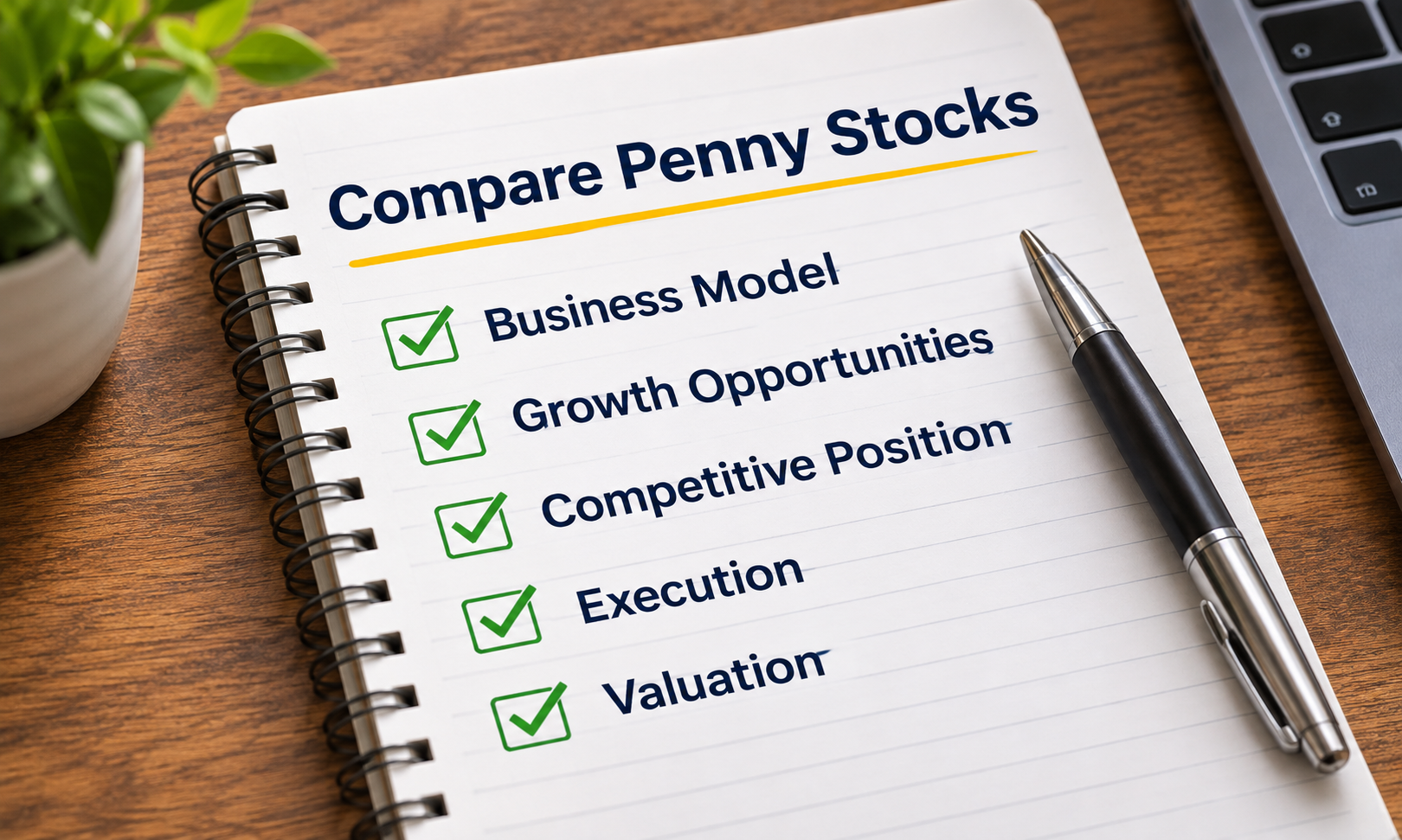
You want to understand how a company makes money. Investors need to look at its products and services, its competitive position, its project pipeline and whether it can turn its plans into a sustainable business.
5. Share Dilution
Smaller companies may issue new shares to raise money. This can help raise money for growth but can dilute the ownership of current shareholders and impact earnings per share if the new money does not earn enough.
Common Mistakes Beginners Should Avoid
A common mistake is to assume that a $0.10 share is automatically cheaper than a $10 share. The real value of a company is not only the price of a single share but its market capitalisation, its financial situation and its future profit possibilities.
Another mistake is to just use market capitalisation while valuing a penny stock. A low market cap might mean a company is small, but it doesn't mean its shares are necessarily undervalued. Before making any conclusions, investors should look at the company’s assets, liabilities, cash flow and business prospects.
New investors should also be wary of hype, speculative news releases and rapid price changes. Penny stocks are known to have volatile share prices due to the limited trading activity and fluctuating market sentiment.
How to Approach Penny Stocks as a Beginner
The smart way to start is with research and risk management. The first step for investors is to look for companies with a simple to understand business model. They should then look at the company’s financial reports and compare the market capitalisation with other similar businesses.
Another important consideration is position sizing. Penny stocks are extremely volatile, so putting a large portion of your portfolio into one speculative company increases your overall risk. Diversification and a clear investment strategy can help to reduce exposure.
Investors should not just look for quick profits. They should also see whether a company has the financial ability, operating ability and realistic growth prospects to sustain its long-term development.
Risk Considerations
Penny stocks are highly risky including low liquidity, price volatility, uncertain earnings and greater dependence on external financing. Smaller companies can also face operational hiccups, regulatory hurdles and difficulty accessing capital. Market capitalisation is a good measure of company size but doesn’t tell you whether a stock is fairly valued or financially sound. Investors should conduct their own research and assess their risk tolerance before investing.
Disclaimer:
General Financial Product Advice and Regulatory Framework: Pristine Gaze Pty Ltd (ABN 66 680 815 678, ACN 680 815 678) operates as Corporate Authorised Representative (CAR No. 001312049) of Alpha Securities Pty Ltd (AFSL 330757), which is licensed and regulated by the Australian Securities and Investments Commission under the Corporations Act 2001 (Cth). This report contains general financial product advice only and has been prepared without consideration of your personal objectives, financial situation, specific needs, circumstances, or investment experience. The information is not tailored to individual circumstances and may not be suitable for your particular situation. Before acting on any information contained herein, you should carefully consider its appropriateness having regard to your personal objectives, financial situation, and needs, and consider seeking personal financial advice from a qualified financial adviser who can assess your individual circumstances and provide tailored recommendations.
Investment Risks and Market Warnings: All investments carry significant risk, and different investment strategies may carry varying levels of risk exposure including total loss of invested capital. The value of investments and income derived from them can fluctuate significantly due to market conditions, economic factors, company-specific events, regulatory changes, commodity price volatility, currency fluctuations, interest rate movements, and other factors beyond our control. Securities markets are subject to market risk from general economic conditions and investor sentiment, liquidity risk affecting the ability to buy or sell securities at desired prices, credit risk from issuer default or deterioration, operational risk from inadequate internal processes, sector-specific risks including industry regulatory changes, technology obsolescence, management changes, competitive pressures, supply chain disruptions, and mining-specific risks including resource estimation uncertainty, operational hazards, environmental compliance, permitting delays, commodity price cycles, geopolitical factors affecting mining operations, and exploration risks. Small-cap and speculative mining stocks carry additional risks including limited liquidity, higher volatility, dependence on key personnel, limited operating history, uncertain cash flows, and potential failure to achieve commercial production.
Information Accuracy and Limitations: While we endeavour to ensure information accuracy and reliability, we make no representations or warranties (express or implied) regarding the accuracy, reliability, completeness, timeliness, or suitability of information provided, except where liability cannot be excluded under applicable law. This report may include information from third-party sources including company announcements, regulatory filings, research reports, market data providers, financial news services, and publicly available information, which we do not independently verify and for which we assume no responsibility. Past performance, examples, historical data, or projections are not indicative of future results, and no guarantee of future returns is provided or implied. To the maximum extent permitted by law, Pristine Gaze Pty Ltd and Alpha Securities Pty Ltd, together with their respective directors, officers, employees, representatives, and related entities, exclude all liability for any errors, omissions, inaccuracies, loss or damage (including direct, indirect, consequential, or special damages) arising from reliance on information provided, investment decisions made based on this report, market losses, opportunity costs, and technical issues or system failures.
Frequently Asked Questions
Common questions about investing and market research to help guide your decisions.