
What Is a Dividend Payout Ratio and Why Does It Matter?
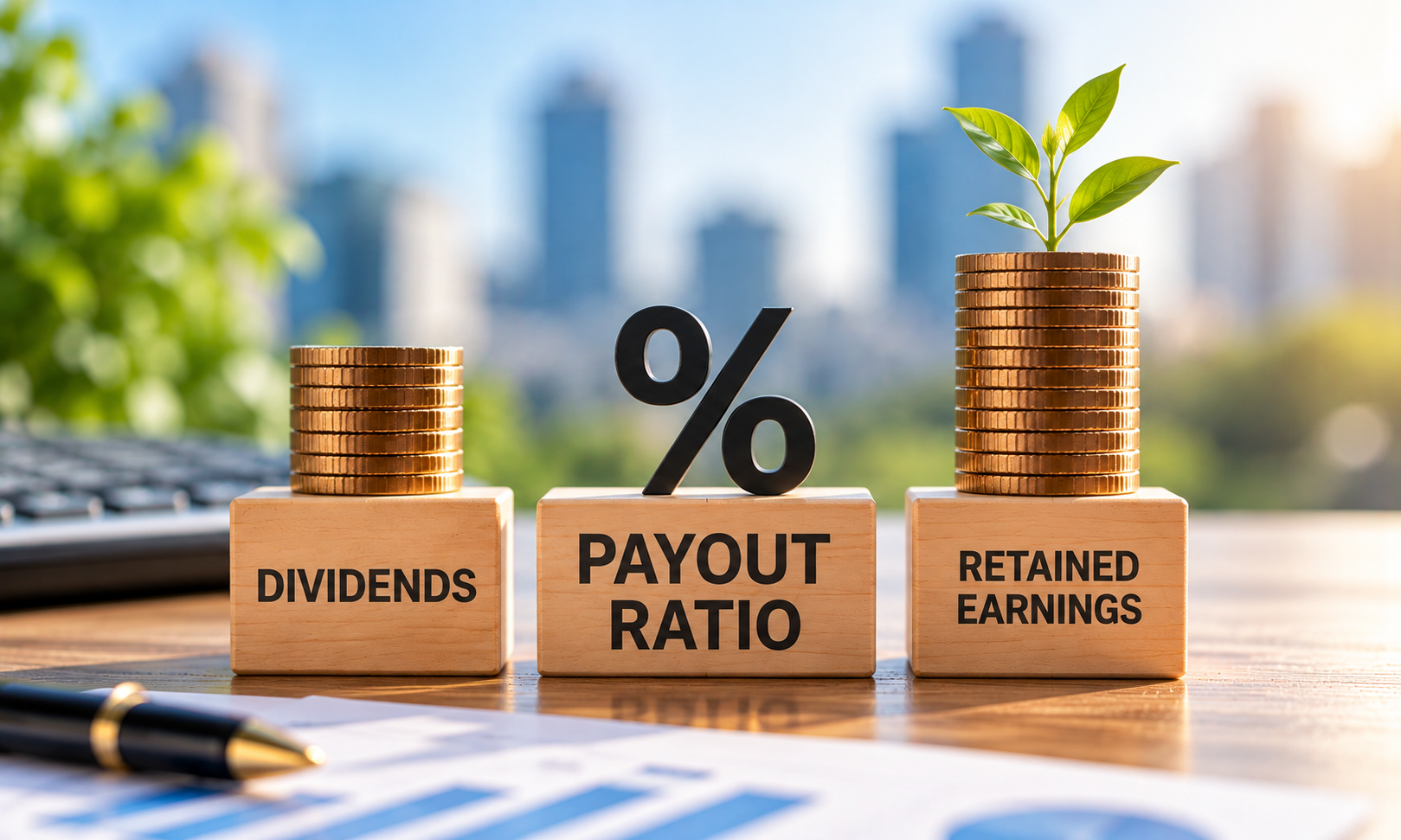
For those seeking income from their equity portfolios, dividends may be a very essential aspect of investing. But a company’s dividend payout doesn’t tell you if that income is sustainable. Investors also need to know what percentage of the company's profits are being paid out to shareholders and how much is being reinvested to finance future growth.
This is when the dividend payout ratio comes into play. It indicates the percentage of a company’s income that is handed out to shareholders as dividends and helps investors evaluate its dividend policy and financial priorities. For Australian investors investigating ASX-listed firms, understanding this statistic might provide important information when comparing dividend-paying corporations and trying to determine whether their payments seem sustainable.
What Is a Dividend Payout Ratio?
The dividend payout ratio displays what percentage of a company's net profit is paid out to shareholders as dividends. The balance of earnings are usually
retained in the business and can be used to fund expansion, repay debt, increase cash reserves or finance other company activities.
The higher the payout ratio the more of the reported earnings are being paid out to the shareholders. A low ratio implies that the corporation is retaining a bigger proportion of its earnings. Both are not excellent or bad in themselves since the proper level relies on the industry of the firm, the potential for growth, the financial condition and the dividend policy.
For example, a business that is well-established and has generally predictable earnings may pay out a big proportion of its profits because it has fewer options to reinvest large amounts into expansion. A younger, fast-growing company might retain most of its earnings to invest in new products, new markets or better operations.
The dividend payout ratio allows investors to see the difference, rather than just rating a company on its dividend yield or the size of its most recent payment.
How to Calculate the Dividend Payout Ratio
The dividend payout ratio can be calculated using a company's total dividends and net profit, or by comparing dividends per share with earnings per share.
Formula using total figures:
Dividend Payout Ratio = (Total Dividends Paid ÷ Net Income) × 100
Formula using per-share figures:
Dividend Payout Ratio = (Dividend Per Share ÷ Earnings Per Share) × 100
Imagine an ASX firm that makes a net profit of $100 million per year and pays $40 million in dividends. Its dividend pay-out ratio would be 40 percent.
This means that the corporation has paid out 40% of its declared profit to shareholders and kept the other 60% for itself. The retained portion may be used by management to fund future operations, investment or debt reduction.
Or another firm reports earnings of $2.00 per share and pays a dividend of $1.00 per share annually. Its payout ratio would be 50 per cent.
These calculations are simple, but investors should be sure that the earnings and dividend statistics represent similar reporting periods. They should also verify whether the amounts are for ordinary dividends, if special dividends are included or if they are based on adjusted earnings rather than statutory net profit.
What Is Considered a Good Dividend Payout Ratio?
There is no one payout ratio that works for all companies. While a 40% ratio may be acceptable for one organisation, it may not be for another, depending on the stability of earnings, capital requirements and potential for future investment.
As a rule of thumb, a payout ratio below 40% suggests a corporation keeps a very high share of its earnings. This may offer the flexibility to finance development or tough periods, but it does not necessarily mean the organisation is financially healthy.
A ratio of between 40-70% may indicate a balance between distributing profits to shareholders and preserving earnings for business requirements. But whether this range is suitable or not depends on the company’s situation.
If the payout ratio is greater than 70% then the company is dispersing a substantial percentage of its earnings. This could be sustainable for some established organisations with stable earnings, but it leaves less room to absorb a drop in profitability or meet unforeseen financial needs.
Investors should use these ranges as rough guides, not as strict rules. The dividend payout ratio should be considered in conjunction with other financial metrics and the past performance of the company.
Why Does the Dividend Payout Ratio Matter?
1. Assessing Dividend Sustainability
The dividend payout ratio is useful for helping investors determine if a firm is capable of continuing to pay its dividend. A corporation that distributes nearly all its earnings may have limited room to manoeuvre if profits fall.
For example, a corporation with a regularly high payout ratio can be pressured to cut its dividend if revenues decrease unexpectedly or operational costs rise. A corporation that maintains more of its earnings may have more flexibility, but its capacity to continue making payments also depends on cash flow, debt and other financial commitments.
Consequently, a payout ratio should be evaluated throughout numerous reporting periods rather than on the basis of a one-year outcome.
2. Understanding a Company's Growth Priorities
The ratio can also demonstrate how management views payouts to shareholders compared to reinvestment. A company seeking to grow significantly may keep more of its profits to fund new projects, technology or capacity.
Conversely, a mature company with less attractive reinvestment prospects may pay out more of its earnings. Neither policy is better in the abstract. Investors should evaluate whether the company’s strategy is in line with their objectives and whether the retained earnings are being used efficiently.
3. Comparing Companies Within the Same Industry
The dividend payout ratio might be helpful for investors to evaluate companies with similar business plans. For example, two mature companies in the same industry may have different dividend policies and retention ratios.
But comparing companies in different industries can be misleading as they have varied capital needs, profitability patterns and regulatory obligations. Investors should evaluate these differences before making a judgement as to whether a payout ratio is particularly high or low.
What Are the Limitations of the Dividend Payout Ratio?
The dividend payout ratio is a useful tool but it doesn’t tell you all you need to know about a company’s finances.
First, it is based on accounting earnings, which may not be the cash available to pay dividends. A business may be profitable but have inadequate operating cash flow or large capital expenditure requirements. Looking at cash flow and dividends together can provide a better sense of affordability.
Second, the ratio could look quite high due to abnormally low earnings. Even if a corporation is making a tiny profit, if it distributes dividends, the payout ratio might go up dramatically. If the ratio is above 100%, it signifies that dividends paid exceed reported earnings for the period, which may signal sustainability concerns. But a transitory result doesn't necessarily suggest a dividend cut is unavoidable.
Third, a firm can lose money, and then the ratio is hard to evaluate or compare meaningfully. Investors should consider the reasons for the loss and if the company has enough financial capabilities to maintain its dividends.
Finally, a low payout ratio doesn’t ensure good future returns. The company’s share price, its operational performance and its future dividend decisions are still essential concerns.
How Investors Can Use the Ratio When Analysing ASX Shares
Annual reports, financial statements and dividend announcements are a good place to start for investors interested in firms listed on the ASX. They can look at recent payout ratios, changes in earnings and decide if the company generates enough cash to justify its payouts.
Also relevant are debt levels, impending capital requirements and the stated dividend policy of the management. These considerations can help explain why a company pays out a certain percentage of its earnings, and whether that approach is compatible with its financial status.
The dividend payout ratio is best used in conjunction with a broader valuation that includes dividend yield, earnings growth, cash flow, balance sheet strength and valuation. Considered as a whole, these variables provide more information than any one number in analysing dividend-paying equities.
Risk Considerations
Dividend payments are not guaranteed and can be lowered, suspended or withdrawn if a company's financial status deteriorates. A low payout ratio does not mean investment risk has been eliminated, a high ratio does not mean a dividend is unsustainable. And accounting earnings may not equal cash accessible. One-time events can affect results. Investors should look at a company’s financial statements, cash flow, debt commitments and business forecast before investing.
Disclaimer:
General Financial Product Advice and Regulatory Framework: Pristine Gaze Pty Ltd (ABN 66 680 815 678, ACN 680 815 678) operates as Corporate Authorised Representative (CAR No. 001312049) of Alpha Securities Pty Ltd (AFSL 330757), which is licensed and regulated by the Australian Securities and Investments Commission under the Corporations Act 2001 (Cth). This report contains general financial product advice only and has been prepared without consideration of your personal objectives, financial situation, specific needs, circumstances, or investment experience. The information is not tailored to individual circumstances and may not be suitable for your particular situation. Before acting on any information contained herein, you should carefully consider its appropriateness having regard to your personal objectives, financial situation, and needs, and consider seeking personal financial advice from a qualified financial adviser who can assess your individual circumstances and provide tailored recommendations.
Investment Risks and Market Warnings: All investments carry significant risk, and different investment strategies may carry varying levels of risk exposure including total loss of invested capital. The value of investments and income derived from them can fluctuate significantly due to market conditions, economic factors, company-specific events, regulatory changes, commodity price volatility, currency fluctuations, interest rate movements, and other factors beyond our control. Securities markets are subject to market risk from general economic conditions and investor sentiment, liquidity risk affecting the ability to buy or sell securities at desired prices, credit risk from issuer default or deterioration, operational risk from inadequate internal processes, sector-specific risks including industry regulatory changes, technology obsolescence, management changes, competitive pressures, supply chain disruptions, and mining-specific risks including resource estimation uncertainty, operational hazards, environmental compliance, permitting delays, commodity price cycles, geopolitical factors affecting mining operations, and exploration risks. Small-cap and speculative mining stocks carry additional risks including limited liquidity, higher volatility, dependence on key personnel, limited operating history, uncertain cash flows, and potential failure to achieve commercial production.
Information Accuracy and Limitations: While we endeavour to ensure information accuracy and reliability, we make no representations or warranties (express or implied) regarding the accuracy, reliability, completeness, timeliness, or suitability of information provided, except where liability cannot be excluded under applicable law. This report may include information from third-party sources including company announcements, regulatory filings, research reports, market data providers, financial news services, and publicly available information, which we do not independently verify and for which we assume no responsibility. Past performance, examples, historical data, or projections are not indicative of future results, and no guarantee of future returns is provided or implied. To the maximum extent permitted by law, Pristine Gaze Pty Ltd and Alpha Securities Pty Ltd, together with their respective directors, officers, employees, representatives, and related entities, exclude all liability for any errors, omissions, inaccuracies, loss or damage (including direct, indirect, consequential, or special damages) arising from reliance on information provided, investment decisions made based on this report, market losses, opportunity costs, and technical issues or system failures.
Frequently Asked Questions
Common questions about investing and market research to help guide your decisions.