How Inflation Impacts Retirement Savings
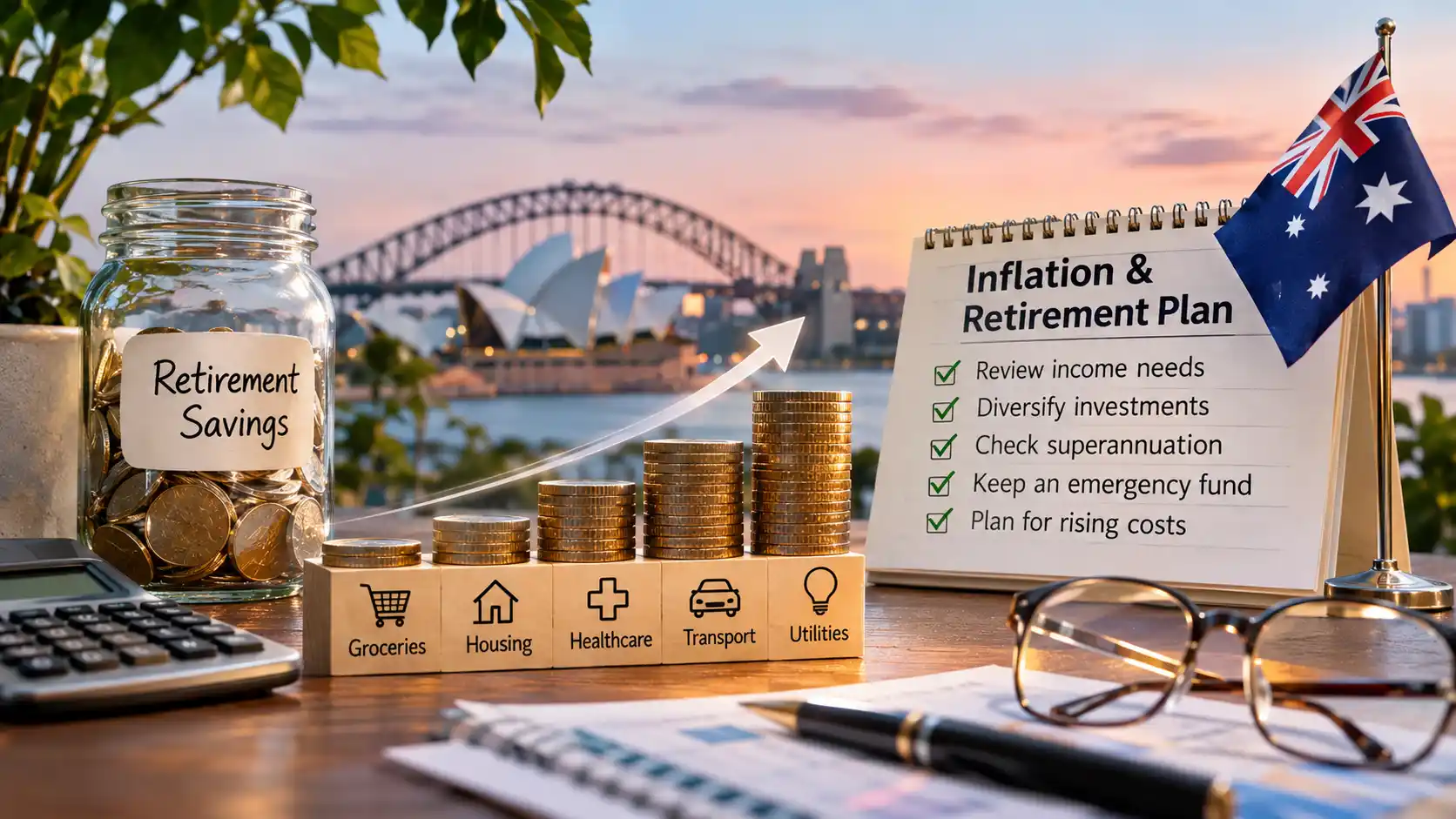
Retirement planning is more than just building a savings balance. Think also about how the cost of living might alter over time. Things such as groceries, housing, healthcare, transport and utilities can cost more, impacting how much income retirees need to maintain their lifestyle.
This is where inflation and retirement go hand in hand. Inflation eats away at the value of your money slowly. So, while you may be saving a certain amount, it may not go as far in the future. Understanding this link helps Australians to plan for retirement with a more realistic long-term financial strategy.
What Is Inflation and How Does It Work?
Inflation is the general increase in the price of goods and services over time. As inflation rises, the purchasing power of money declines because customers will have to pay more money to obtain the same products and services.
The Australian Bureau of Statistics releases the Consumer Price Index (CPI) as the standard indicator of inflation in Australia. It measures the change in price of a basket of home goods and services.
Say, for instance, that the cost of everyday costs goes up. Then a household may be forced to spend a bigger chunk of its income on groceries, power, transit and other things. Even if you save the same amount, you will slowly lose your ability to pay for these expenses.
How Inflation Impacts Retirement Savings
Inflation can affect retirement planning in several ways, particularly when individuals expect their savings to support them over an extended period.
1. Reduces Purchasing Power
The biggest effects of inflation include a slow erosion of buying power. Money saved now may not have the same purchasing power in the future.
This might be a problem for retirees living on a fixed amount of savings or income. With an increase in their daily costs, people may need to dip into their savings more to maintain the same lifestyle.
2. Increases Retirement Living Expenses
Retirement expenses aren't always a consistent amount. Healthcare, insurance, food, housing and utility prices are subject to alter with time.
Health care can become increasingly vital as people age and require more medical treatments or help. If you don’t factor rising expenses into your retirement planning, you may have a harder time being financially comfortable.
3. Affects the Value of Cash Savings
Savings accounts can offer stability and quick access to cash. But if the interest earned is less than the rate of inflation, the real purchasing power of those funds goes down.
That’s not to say cash has no place in retirement preparation. It can be used to address crises and short-term needs, but reliance on cash alone can be a constraint on maintaining purchasing power over longer terms.
4. Creates Pressure on Retirement Income
Higher inflation can put more burden on retirees who depend on regular withdrawals from savings. They may have to pull out more to cope with rising living expenditures.
Taking out more money can lessen the amount left invested and change how long retirement savings endure. That makes it important to factor inflation into any estimate of future income needs.
How Can Australians Prepare for Inflation During Retirement?
Although inflation cannot be controlled by individual investors, retirement planning can account for its potential effects. A few practical considerations can help individuals prepare.
Review Retirement Income Needs Regularly
Costs of living fluctuate, and so should retirement finances. Instead of assuming today's spending rate would continue, folks might think about how necessary spending might increase over time.
Consider Diversification
Inflation and shifting economic conditions can impact different asset classes in different ways. A diversified portfolio could comprise shares, bonds, property-related investments and cash,
Diversifying won’t eliminate the danger of investing, but it can help you not to rely on only one sort of asset.
Understand the Role of Superannuation
Superannuation is a vital component of retirement planning in Australia. People should know what their superannuation is invested in, what fees they are paying and if their investment strategy is still appropriate for their retirement horizon.
The correct technique will depend on your age, your income needs and your desire to ride out market ups and downs.
Maintain an Emergency Cash Reserve
Having accessible savings can help retirees manage unexpected costs without having to sell long-term investments immediately. But you should think of the amount of cash you have in terms of inflation and how that may affect your purchasing power.
Why Is Long-Term Retirement Planning Important?
Inflation can eat away at your retirement dollars, but slowly. The effect may not be evident in the short term, but the cost increases can become more significant over a long retirement.
If you start planning for retirement early, you’ll have more time to let your funds grow, evaluate investment selections and alter financial objectives. And those nearing retirement age may also benefit from checking periodically whether their estimated income will be sufficient to meet their future living costs.
The trick is not to think of retirement savings as a set amount. Their intrinsic worth depends on what that money can buy over time.
Risk Considerations
Inflation rates can vary and returns on investment are not guaranteed to keep pace with the rising expense of living. Investing in shares, bonds and property involves risk. Too much cash may mean less buying power. Your retirement planning should factor in your individual circumstances, investment timeframes, income demands and tolerance for market volatility.
Disclaimer:
General Financial Product Advice and Regulatory Framework: Pristine Gaze Pty Ltd (ABN 66 680 815 678, ACN 680 815 678) operates as Corporate Authorised Representative (CAR No. 001312049) of Alpha Securities Pty Ltd (AFSL 330757), which is licensed and regulated by the Australian Securities and Investments Commission under the Corporations Act 2001 (Cth). This report contains general financial product advice only and has been prepared without consideration of your personal objectives, financial situation, specific needs, circumstances, or investment experience. The information is not tailored to individual circumstances and may not be suitable for your particular situation. Before acting on any information contained herein, you should carefully consider its appropriateness having regard to your personal objectives, financial situation, and needs, and consider seeking personal financial advice from a qualified financial adviser who can assess your individual circumstances and provide tailored recommendations.
Investment Risks and Market Warnings: All investments carry significant risk, and different investment strategies may carry varying levels of risk exposure including total loss of invested capital. The value of investments and income derived from them can fluctuate significantly due to market conditions, economic factors, company-specific events, regulatory changes, commodity price volatility, currency fluctuations, interest rate movements, and other factors beyond our control. Securities markets are subject to market risk from general economic conditions and investor sentiment, liquidity risk affecting the ability to buy or sell securities at desired prices, credit risk from issuer default or deterioration, operational risk from inadequate internal processes, sector-specific risks including industry regulatory changes, technology obsolescence, management changes, competitive pressures, supply chain disruptions, and mining-specific risks including resource estimation uncertainty, operational hazards, environmental compliance, permitting delays, commodity price cycles, geopolitical factors affecting mining operations, and exploration risks. Small-cap and speculative mining stocks carry additional risks including limited liquidity, higher volatility, dependence on key personnel, limited operating history, uncertain cash flows, and potential failure to achieve commercial production.
Information Accuracy and Limitations: While we endeavour to ensure information accuracy and reliability, we make no representations or warranties (express or implied) regarding the accuracy, reliability, completeness, timeliness, or suitability of information provided, except where liability cannot be excluded under applicable law. This report may include information from third-party sources including company announcements, regulatory filings, research reports, market data providers, financial news services, and publicly available information, which we do not independently verify and for which we assume no responsibility. Past performance, examples, historical data, or projections are not indicative of future results, and no guarantee of future returns is provided or implied. To the maximum extent permitted by law, Pristine Gaze Pty Ltd and Alpha Securities Pty Ltd, together with their respective directors, officers, employees, representatives, and related entities, exclude all liability for any errors, omissions, inaccuracies, loss or damage (including direct, indirect, consequential, or special damages) arising from reliance on information provided, investment decisions made based on this report, market losses, opportunity costs, and technical issues or system failures.
Frequently Asked Questions
Common questions about investing and market research to help guide your decisions.