How to Read an ASX Annual Report
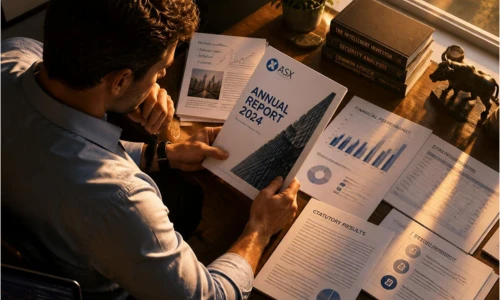
An annual report is one of the most useful documents for investors who want to understand how an ASX-listed company performed over the past financial year and where management expects the business to go next.
However, annual reports can be long and filled with financial terminology, making them difficult to read from beginning to end. The good news is that investors do not need to study every page. Knowing which sections matter most can make the process much easier.
Understanding how to read annual report information can help investors assess a company's financial health, growth prospects, risks, and overall business quality before making an investment decision.
What Is an Annual Report?
An annual report is a comprehensive document published by a listed company each year. It provides information about the company's financial performance, operations, strategy, management, risks, and future outlook.
For investors, the annual report can answer important questions such as:
- Is the company growing?
- Is it profitable?
- How much cash does it generate?
- Does it have too much debt?
- What are its major risks?
- Where does management expect future growth to come from?
Rather than focusing only on the share price, investors can use the annual report to understand the underlying business.
Start With the Chairman and CEO Letter
One of the easiest places to begin is the chairman's letter or CEO's review.
This section generally provides management's perspective on the company's performance during the year, major achievements, challenges, and strategic priorities.
Look for explanations about:
- Revenue growth
- Major business developments
- New markets
- Acquisitions
- Cost pressures
- Operational challenges
- Future priorities
Management naturally presents the company in a positive way, so investors should not rely on this section alone. Instead, use it to understand what management believes are the company's most important opportunities and challenges before checking the financial statements.
Understand the Business
Before analysing numbers, investors should understand what the company actually does and how it makes money.
Look at the business overview and segment information to identify the company's major products, services, customers, and markets.
Ask simple questions:
- Where does the revenue come from?
- Which business segments are growing?
- Which markets are most important?
- Does the company depend heavily on one customer or product?
Understanding the business model makes the financial numbers much easier to interpret.
Read the Income Statement
The income statement shows how the company performed financially during the reporting period.
Key figures include revenue, operating expenses, operating profit, and net profit.
Revenue shows how much money the company generated from its operations. Investors should compare current revenue with previous years to determine whether the business is growing.
Net profit shows what remains after expenses, interest, taxes, and other costs.
However, investors should not look at profit in isolation. A company can report strong profit growth while its cash generation remains weak.
It is therefore useful to examine both profit growth and cash flow.
Look at the Balance Sheet
The balance sheet provides a snapshot of the company's financial position.
Important areas include:
- Cash
- Debt
- Assets
- Liabilities
- Shareholders' equity
Cash is particularly important because it provides the company with financial flexibility.
Debt should also be examined carefully. A company with manageable debt may have greater flexibility during difficult economic conditions, while highly leveraged businesses can face greater pressure when interest rates rise or earnings decline.
Investors should compare debt with cash generation rather than simply looking at the absolute debt figure.
Don't Skip the Cash Flow Statement
The cash flow statement is one of the most important sections when learning how to read annual report information.
It shows how cash moved through the business during the year.
Operating cash flow is particularly useful because it indicates how much cash the company's core operations are generating.
Investors should consider whether cash flow is broadly supporting reported earnings.
If profit continues rising but operating cash flow remains weak, it may be worth investigating why.
Capital expenditure is another important area. Businesses often need to spend money on equipment, technology, infrastructure, or expansion to maintain and grow operations.
Read the Notes to the Financial Statements
The financial statements provide the headline numbers, but the notes can explain what those numbers actually mean.
Notes may provide additional information about:
- Accounting policies
- Debt
- Acquisitions
- Business segments
- Property and equipment
- Employee benefits
- Leases
- Taxation
- Contingent liabilities
Investors do not necessarily need to read every note in detail. Instead, focus on areas connected to major changes in the company's financial results.
For example, if debt increased significantly, look for the relevant note explaining why.
Check the Company's Risks
Every annual report contains information about risks that could affect the company's future performance.
These can include economic conditions, competition, regulation, supply chains, technology, interest rates, foreign exchange movements, cybersecurity, or dependence on specific markets.
Investors should consider whether these risks are increasing or decreasing.
It can also be useful to compare the risks mentioned in the current annual report with previous years to see whether the company's risk profile has changed.
Look at Management's Outlook
After reviewing historical performance, investors should consider what comes next.
The outlook section can provide information about expected demand, expansion plans, investment priorities, cost management, and strategic objectives.
However, future expectations are not guarantees.
Investors should compare management's outlook with the company's financial position and industry conditions to determine whether the strategy appears realistic.
Watch for Red Flags
Learning how to read annual report information also means knowing what deserves further investigation.
Potential warning signs can include:
- Falling revenue
- Declining margins
- Weak operating cash flow
- Rapidly increasing debt
- Frequent capital raisings
- Rising expenses without corresponding growth
- Heavy dependence on one customer or market
- Significant changes in accounting assumptions
- Increasing regulatory or legal risks
A single warning sign does not necessarily mean a company is a poor investment. The important point is to understand why the change occurred and whether it could affect future performance.
Build a Simple Investment View
After reviewing the annual report, investors should be able to answer a few basic questions.
- Is the business growing?
- Is it financially healthy?
- Is it generating cash?
- Does it have manageable debt?
- What are the biggest risks?
- What could drive future growth?
If these questions cannot be answered clearly, further research may be required before making an investment decision.
Risk Considerations
Annual reports provide valuable information but cannot predict future share price performance. Historical financial results may not continue, while management forecasts and outlook statements can change as market conditions develop. Investors should also consider valuation, industry conditions, competitive pressures, debt levels, cash flow, and company-specific risks rather than relying on a single annual report. Understanding how to read annual report information can improve the research process, but investment decisions should be based on a broader assessment of the company and its prospects.
Disclaimer:
General Financial Product Advice and Regulatory Framework: Pristine Gaze Pty Ltd (ABN 66 680 815 678, ACN 680 815 678) operates as Corporate Authorised Representative (CAR No. 001312049) of Alpha Securities Pty Ltd (AFSL 330757), which is licensed and regulated by the Australian Securities and Investments Commission under the Corporations Act 2001 (Cth). This report contains general financial product advice only and has been prepared without consideration of your personal objectives, financial situation, specific needs, circumstances, or investment experience. The information is not tailored to individual circumstances and may not be suitable for your particular situation. Before acting on any information contained herein, you should carefully consider its appropriateness having regard to your personal objectives, financial situation, and needs, and consider seeking personal financial advice from a qualified financial adviser who can assess your individual circumstances and provide tailored recommendations.
Investment Risks and Market Warnings: All investments carry significant risk, and different investment strategies may carry varying levels of risk exposure including total loss of invested capital. The value of investments and income derived from them can fluctuate significantly due to market conditions, economic factors, company-specific events, regulatory changes, commodity price volatility, currency fluctuations, interest rate movements, and other factors beyond our control. Securities markets are subject to market risk from general economic conditions and investor sentiment, liquidity risk affecting the ability to buy or sell securities at desired prices, credit risk from issuer default or deterioration, operational risk from inadequate internal processes, sector-specific risks including industry regulatory changes, technology obsolescence, management changes, competitive pressures, supply chain disruptions, and mining-specific risks including resource estimation uncertainty, operational hazards, environmental compliance, permitting delays, commodity price cycles, geopolitical factors affecting mining operations, and exploration risks. Small-cap and speculative mining stocks carry additional risks including limited liquidity, higher volatility, dependence on key personnel, limited operating history, uncertain cash flows, and potential failure to achieve commercial production.
Information Accuracy and Limitations: While we endeavour to ensure information accuracy and reliability, we make no representations or warranties (express or implied) regarding the accuracy, reliability, completeness, timeliness, or suitability of information provided, except where liability cannot be excluded under applicable law. This report may include information from third-party sources including company announcements, regulatory filings, research reports, market data providers, financial news services, and publicly available information, which we do not independently verify and for which we assume no responsibility. Past performance, examples, historical data, or projections are not indicative of future results, and no guarantee of future returns is provided or implied. To the maximum extent permitted by law, Pristine Gaze Pty Ltd and Alpha Securities Pty Ltd, together with their respective directors, officers, employees, representatives, and related entities, exclude all liability for any errors, omissions, inaccuracies, loss or damage (including direct, indirect, consequential, or special damages) arising from reliance on information provided, investment decisions made based on this report, market losses, opportunity costs, and technical issues or system failures.
Frequently Asked Questions
Common questions about investing and market research to help guide your decisions.