
How to Evaluate Biotech Stocks Before Investing
How to Evaluate Biotech Stocks Before Investing
Biotech companies can attract investors because their research may result in new medicines, treatments and medical technologies But investing in biotech is not investing in a business that has a history of consistent revenue and financial history. A company’s value can depend on the outcome of clinical trials, regulatory decisions, access to funding and whether its research can be turned into a commercially viable product. Even promising scientific developments do not always mean commercial success. Knowing how to analyse biotech stocks involves looking at both the science that underlies a company's products, and the financial resources needed to bring those products to market. For Australian investors, learning how to evaluate these factors can provide a more structured way of evaluating opportunities and understanding the risks involved.
Understand the Company’s Business Model
Before looking at financial figures, investors need to understand what the biotech company does and how it expects to make money. Some develop their own medicines. Others develop diagnostics, biological products, research platforms or technologies that are licensed to larger pharmaceutical companies. Their funding needs and revenue models can be very different.
For instance, a firm developing a new drug might spend years on research and clinical trials before it generates meaningful product revenue. Another choice is for a company to license its technology to a commercial partner, which pays a fee that could be an upfront payment, a development milestone or a royalty. Investors should identify what are the major products of the company, the level of development, the target market and the expected commercial path. A commercial strategy that is deliverable is distinguished from a research program which still has to overcome major scientific and financial hurdles by a clear business model
. 
Assess the Stage of the Clinical Trial
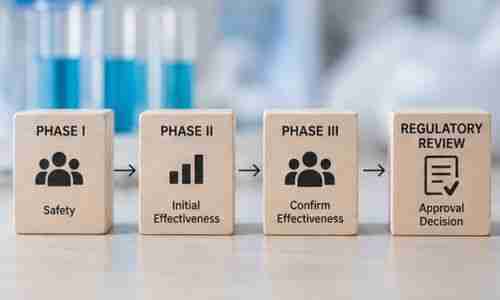
Progress in clinical trials is one of the most important factors in evaluating many biotech companies. Medicines usually undergo different phases of testing, but the path of development may vary depending on the product and the design of the trials. Early-stage studies, often called Phase I, primarily focus on safety, tolerability and correct dosing. Phase II trials look at whether a treatment works in patients, while still monitoring safety. This is usually done in a larger patient group . Phase III trials are designed to confirm effectiveness and further investigate safety profile .
Crucially, moving to a later stage does not mean that approval will be given. Investors should look at what the latest trial actually demonstrated, how many patients took part, whether the results achieved the stated goals of the study and what limitations still exist. A positive announcement should be evaluated on the full findings and not just the headline. It also helps to identify the next anticipated milestone, such as further trial results or a regulatory submission, and understand what needs to happen before the company can move forward. The Therapeutic Goods Administration gives guidance on the phases of a clinical trial and their objectives.
Check cash reserves and funding needs.
Biotech research can be costly, and some companies run for long stretches without meaningful commercial revenue. Thus, their ability to continue developing products is largely dependent on their cash position. Investors need to look at the latest financial reports, cash balance, operating cash outflows and planned research spend to see what money is still available.
Cash runway is the length of time a company can keep operating before it has to get more money, assuming that it keeps spending cash at a certain rate. Spending can change due to clinical trials and manufacturing requirements and unexpected expenses, so it is an estimate rather than a guarantee. Investors should also ask themselves if the company will need to raise more capital before it hits its next major milestone. Capital raising can raise funds for development, but if new shares are issued, the ownership of existing shareholders may be diluted if they do not participate. Strong scientific progress is less meaningful if the company does not have enough resources to carry its research into the next stages.
Evaluate Quality of Clinical Evidence
Not all positive trials provide the same level of evidence. Investors should ask whether a study’s primary endpoint, the main outcome the trial was designed to measure, was met. They should also consider the size of benefit observed, the number of patients studied, duration of follow-up, and any safety concerns reported. Comparing the trial results with existing treatments, where appropriate, can give investors a sense of the potential value of a new product.
Early results can be encouraging, but smaller studies may not give as much confidence about how a treatment will perform in a wider patient population. The outcomes of additional trials may be different, and unanticipated side effects may alter plans for development. Investors should therefore differentiate between early scientific promise and better evidence that a product is effective and acceptably safe for its intended use. Looking at independent scientific publications and company disclosures with details can be useful for providing context beyond promotional summaries.
Read About Regulatory Approval & Commercial Potential
Biotech products generally are subject to certain regulatory requirements before they may be marketed for an approved use. In Australia, therapeutic goods, including medicines, are evaluated by the Therapeutic Goods Administration (TGA) for issues including safety, quality and efficacy. Where applicable, approved products are listed on the Australian Register of Therapeutic Goods. But getting regulatory approval is only one part of the commercial process.
Does the company have a realistic plan to manufacture, distribute and sell its product? These are things that investors should consider. Relevant factors may include, but are not limited to, production costs, competition, market demand, pricing, reimbursement arrangements and the resources needed to reach healthcare providers. A treatment can be meeting a major medical need and still be commercially challenged if it’s complicated to make or access is limited. Partnerships with established drug companies can bring development expertise, funding or distribution capabilities, but the value of such deals hinges on the terms and the responsibilities each party takes on.
Review Intellectual Property and Strategic Alliances
Intellectual property can be important for a biotech company’s ability to protect its technology and to compete commercially. Investors should verify if the business holds relevant patents, licenses technology from another entity or depends on intellectual property owned by a partner. Patent protection, licensing terms and disputes may impact the amount of commercial value the company ultimately retains.
Partnerships can also give smaller businesses access to funding, scientific expertise, or commercial infrastructure. But announced collaboration does not necessarily guarantee future revenue or successful product development. Investors should read the terms to understand upfront payments, milestone conditions, royalty arrangements and ongoing obligations. It is also worth considering whether the company is heavily reliant on one product, patent or partner, as this concentration can add uncertainty if a key relationship or development program fails.
Risk Factors
Biotech stocks can be very volatile and their prospects depend on trial results, regulatory decisions and future funding. Clinical programs may not succeed, approval may be delayed or refused and promising treatments may not become commercially successful. If a company doesn’t have a lot of cash on hand, it may need to raise capital, possibly diluting existing shareholders. Intellectual property disputes, manufacturing challenges and competition can also impact future prospects. Investors should look at the strength of the evidence, the funding requirements, the development timetable and the commercial route rather than just the scientific statements or the swings in the share price. No single trial result or development milestone guarantees a successful investment outcome.
Disclaimer:
General financial product advice and regulatory framework Pristine Gaze Pty Ltd (ABN 66 680 815 678, ACN 680 815 678) is Corporate Authorised Representative No. 001312049 of Alpha Securities Pty Ltd (AFSL 330757) which is licensed and regulated by the Australian Securities and Investments Commission under the Corporations Act 2001 (Cth). This report is for general information only and has been prepared without regard to your objectives, financial situation, specific needs, circumstances or investment experience. The information is general and not tailored to your individual circumstances and may not be appropriate for your specific situation. You should consider the appropriateness of the information contained in this publication having regard to your personal objectives, financial situation and needs before acting on the information. You should consider seeking personal financial advice from a qualified financial adviser who can assess your individual circumstances and provide tailored recommendations.
Market Cautions and Investment Risks: All investments involve risk and, in particular, different investment strategies inherently involve different levels of risk, including the potential for total loss of capital invested. The value of investments and the income from them can go down as well as up and investors may not get back the amount invested. The securities markets are subject to market risk from general economic conditions and investor sentiment, liquidity risk from the ability to buy or sell securities at desired prices, credit risk from issuer default or deterioration, operational risk from inadequate or failed internal processes, industry-specific risks such as changes in industry regulation, technology obsolescence, changes in management, competitive pressures, supply chain disruptions and mining-specific risks such as uncertainty of resource estimation, operational hazards, environmental compliance, permitting delays, commodity price cycles, geopolitical factors impacting mining operations, and exploration risks. Small-cap and speculative mining stocks involve additional risks such as limited liquidity, volatility, dependence on key personnel, limited operating history, uncertain cash flows and the possibility of failing to achieve commercial production.
Accuracy and Limitations of Information: We make no representations or warranties, express or implied, relating to the accuracy, reliability, completeness, timeliness or suitability of any information provided, save where liability cannot be excluded under applicable law, although we endeavour to ensure information accuracy and reliability. This report may contain information obtained from third-party sources including, but not limited to, company announcements, regulatory filings, research reports, market data providers, financial news services and publicly available information, which we do not independently verify and for which we assume no responsibility. Past performance, examples, historical data or projections are not indicative of future results, and no guarantee of future returns is provided or implied. To the maximum extent permitted by law, the directors, officers, employees, representatives and agents of Pristine Gaze Pty Ltd and Alpha Securities Pty Ltd and the directors, officers, employees, representatives and agents of all related bodies corporate of Pristine Gaze Pty Ltd and Alpha Securities Pty Ltd disclaim and exclude all liability for any loss, damage, claim, expense (including direct or indirect consequential damage, special damages, loss of profits or opportunities, damages or loss of any kind) suffered or incurred by the recipient or any other person in connection with or arising out of the contents of this report, the error, omission or inaccuracy in the contents of this report, any investment decision made or not made by the recipient or any other person based on the contents of this report, any market loss, opportunity cost or other damages (including in respect of technical failures or system failures).
Frequently Asked Questions
Common questions about investing and market research to help guide your decisions.