Healthcare ETFs for Australian Investors
Healthcare is a key component of the global economy, encompassing pharmaceuticals, biotechnology, medical devices, healthcare services, and medical research. As populations age and medical technology evolves, companies in these industries continue to develop cures, improve healthcare delivery and create new products. These developments have created an area of interest for investors looking to gain exposure to long-term industry patterns in healthcare.
An Australian investor looking for a Healthcare ETF Australia search might find exchange-traded funds on the Australian Securities Exchange (ASX) that provide exposure to healthcare industries worldwide. Investing in an ETF gives investors exposure to a portfolio of firms with one investment, rather than having to pick individual pharmaceutical or medical technology companies.
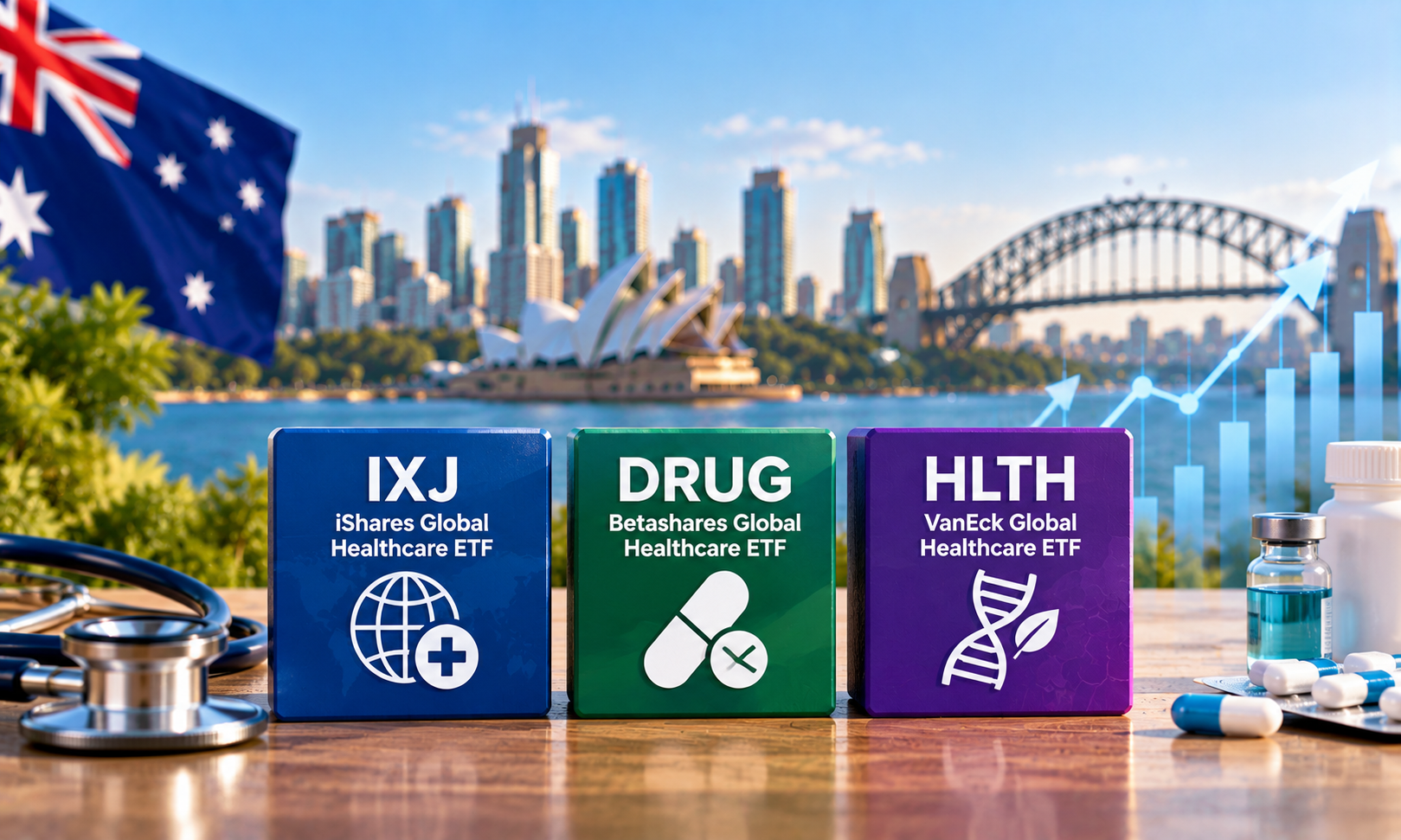
Three choices worth considering are the iShares Global Healthcare ETF (ASX: IXJ), Betashares Global Healthcare Currency Hedged ETF (ASX: DRUG) and VanEck Global Healthcare Leaders ETF (ASX: HLTH). They have distinct investment approaches and investors need to understand what is in the portfolio and the currency exposure and the dangers before investing.
What Is a Healthcare ETF?
A healthcare exchange-traded fund is an investment vehicle that holds shares of firms in the healthcare industry. An ETF may invest in pharmaceutical manufacturers, biotechnology companies, medical equipment makers, healthcare technology companies and other healthcare-related companies, depending on its investment strategy.
Healthcare ETFs provide investors with exposure to a number of firms without having to research and buy each individual stock. But the level of diversification relies on the fund's assets, the weighting of its portfolio and its investment purpose.
Healthcare companies have diverse risk profiles, too. Existing drugs may bring significant revenue for established pharmaceutical companies. Biotechnology companies may be more dependent on research outcomes, clinical trials and regulatory approvals. Understanding these differences is critical comparing healthcare ETFs.
1. iShares Global Healthcare ETF (ASX: IXJ)
Investment Focus
The iShares Global Healthcare ETF from BlackRock offers exposure to healthcare companies around the world. It has investments in pharmaceutical companies, biotech firms, medical device makers and other health care-related industries. The product seeks to mirror the investment results of the S&P Global 1200 Healthcare Sector Capped Index, before fees and expenses.
Investors can explore the fund's strategy and holdings through the official iShares IXJ page.
Potential Benefits
IXJ is a single ASX listed investment that provides broad exposure to global healthcare sector. Its portfolio may provide access to companies involved in the development of pharmaceuticals, manufacturing of medical equipment and the delivery of healthcare-related products and services.
This technique may be attractive to those investors seeking exposure to healthcare, but without reliance on the results of any one particular pharmaceutical or biotechnology business. Having many firms helps diversify company-specific risk but the fund is still subject to wider healthcare-sector moves.
Key Insights
Investors considering IXJ should consider the underlying stocks, geographic exposure, management costs and concentration of the portfolio. While the fund is diversified across multiple healthcare industries, it can still be affected by the demand for pharmaceuticals, breakthroughs in biotech, legislation and market sentiment for healthcare stocks.
2. Betashares Global Healthcare Currency Hedged ETF (ASX: DRUG)
Investment Focus
The Betashares Global Healthcare Currency Hedged ETF allows you to invest in the largest global healthcare businesses, but not those listed on the Australian exchange. Its investment strategy is to replicate the Nasdaq Global ex-Australia Healthcare Hedged AUD Index before fees and expenses. Currency hedging is aimed to mitigate the impact of variations in foreign exchange rates on the Australian dollar.
The portfolio of the fund may comprise companies engaged in pharmaceuticals, biotechnology, medical equipment and other healthcare operations. For more information, please visit the Betashares DRUG official page.
Potential Benefits
DRUG may be a good way for investors to have exposure to international healthcare without having to worry about how currency swings can affect returns. This may make it relevant as a comparison to unhedged global healthcare funds when examining how international assets fit within an Australian portfolio.
The fund also provides access to established healthcare businesses across international markets without requiring investors to purchase each underlying share separately.
Key Insights
Currency hedging does not guaranty higher results. It mitigates some currency-related consequences but may also create new expenses and dangers. The portfolio remains sensitive to world health care stock movements, corporate profits and market valuations.
Investors should check whether the present holdings, hedging method and management fees are consistent with their investment objectives.
3. VanEck Global Healthcare Leaders ETF (ASX: HLTH)
Investment Focus
The VanEck Global Healthcare Leaders ETF provides exposure to worldwide healthcare companies through a portfolio designed to follow the MarketGrader Developed Markets Health Care Net Return AUD Index before fees and expenses. It is targeted to healthcare companies selected based on fundamental measures and growth criteria.
The portfolio can comprise pharmaceutical companies, biotech firms, medical technology suppliers and other healthcare-related industries. Investors can learn more about the fund’s investment technique at the official VanEck HLTH page.
Potential Benefits
HLTH offers an alternative way to play global healthcare investing by targeting specific healthcare companies rather than treating the whole sector as a monolithic market. Its investment strategy can appeal to investors seeking exposure to healthcare enterprises assessed on a fundamental and growth basis.
The fund also gives you access to worldwide companies through an ASX-listed ETF, so you can explore global healthcare exposure without having to buy abroad shares directly.
Key Insights
HLTH’s performance hinges on the firms its underlying index picks and how those holdings perform over time. Its investing strategy does not guaranty that the picked businesses will outperform the broader healthcare market.
Before comparing HLTH with other healthcare ETFs, investors should understand the index methodology, portfolio composition, fees and international exposure.
Comparing These Healthcare ETFs
The three funds offer different approaches to investing in the healthcare industry.
- IXJ: Provides broad global healthcare exposure across pharmaceuticals, biotechnology and medical equipment.
- DRUG: Provides international healthcare exposure with currency hedging against the Australian dollar.
- HLTH: Focuses on selected global healthcare companies using a fundamental and growth-oriented investment methodology.
The most suitable structure depends on an investor's objectives and existing portfolio. Someone seeking broad sector exposure may assess IXJ, while an investor concerned about currency movements may compare DRUG with unhedged alternatives. HLTH may interest investors who prefer its particular company-selection methodology.
Investors should compare the funds' holdings, management costs, diversification, currency exposure and investment objectives rather than choosing solely by fund name or recent performance.
Risk Considerations
Healthcare ETFs are still vulnerable to share market volatility, corporate earnings changes, regulatory decisions and developments in medical research. Expiration of patents can hurt pharmaceutical companies and failures in clinical studies or product approvals can damage biotech enterprises. Currency hedging eliminates some of the foreign-exchange effects but not the investment risk. Before making any investment decisions, investors should study the product disclosure statement, holdings, fees and risk profile of each ETF.
Disclaimer:
General Financial Product Advice and Regulatory Framework: Pristine Gaze Pty Ltd (ABN 66 680 815 678, ACN 680 815 678) operates as Corporate Authorised Representative (CAR No. 001312049) of Alpha Securities Pty Ltd (AFSL 330757), which is licensed and regulated by the Australian Securities and Investments Commission under the Corporations Act 2001 (Cth). This report contains general financial product advice only and has been prepared without consideration of your personal objectives, financial situation, specific needs, circumstances, or investment experience. The information is not tailored to individual circumstances and may not be suitable for your particular situation. Before acting on any information contained herein, you should carefully consider its appropriateness having regard to your personal objectives, financial situation, and needs, and consider seeking personal financial advice from a qualified financial adviser who can assess your individual circumstances and provide tailored recommendations.
Investment Risks and Market Warnings: All investments carry significant risk, and different investment strategies may carry varying levels of risk exposure including total loss of invested capital. The value of investments and income derived from them can fluctuate significantly due to market conditions, economic factors, company-specific events, regulatory changes, commodity price volatility, currency fluctuations, interest rate movements, and other factors beyond our control. Securities markets are subject to market risk from general economic conditions and investor sentiment, liquidity risk affecting the ability to buy or sell securities at desired prices, credit risk from issuer default or deterioration, operational risk from inadequate internal processes, sector-specific risks including industry regulatory changes, technology obsolescence, management changes, competitive pressures, supply chain disruptions, and mining-specific risks including resource estimation uncertainty, operational hazards, environmental compliance, permitting delays, commodity price cycles, geopolitical factors affecting mining operations, and exploration risks. Small-cap and speculative mining stocks carry additional risks including limited liquidity, higher volatility, dependence on key personnel, limited operating history, uncertain cash flows, and potential failure to achieve commercial production.
Information Accuracy and Limitations: While we endeavour to ensure information accuracy and reliability, we make no representations or warranties (express or implied) regarding the accuracy, reliability, completeness, timeliness, or suitability of information provided, except where liability cannot be excluded under applicable law. This report may include information from third-party sources including company announcements, regulatory filings, research reports, market data providers, financial news services, and publicly available information, which we do not independently verify and for which we assume no responsibility. Past performance, examples, historical data, or projections are not indicative of future results, and no guarantee of future returns is provided or implied. To the maximum extent permitted by law, Pristine Gaze Pty Ltd and Alpha Securities Pty Ltd, together with their respective directors, officers, employees, representatives, and related entities, exclude all liability for any errors, omissions, inaccuracies, loss or damage (including direct, indirect, consequential, or special damages) arising from reliance on information provided, investment decisions made based on this report, market losses, opportunity costs, and technical issues or system failures.
Frequently Asked Questions
Common questions about investing and market research to help guide your decisions.