
Growth Stocks vs Blue Chip Stocks: Key Differences for Investors
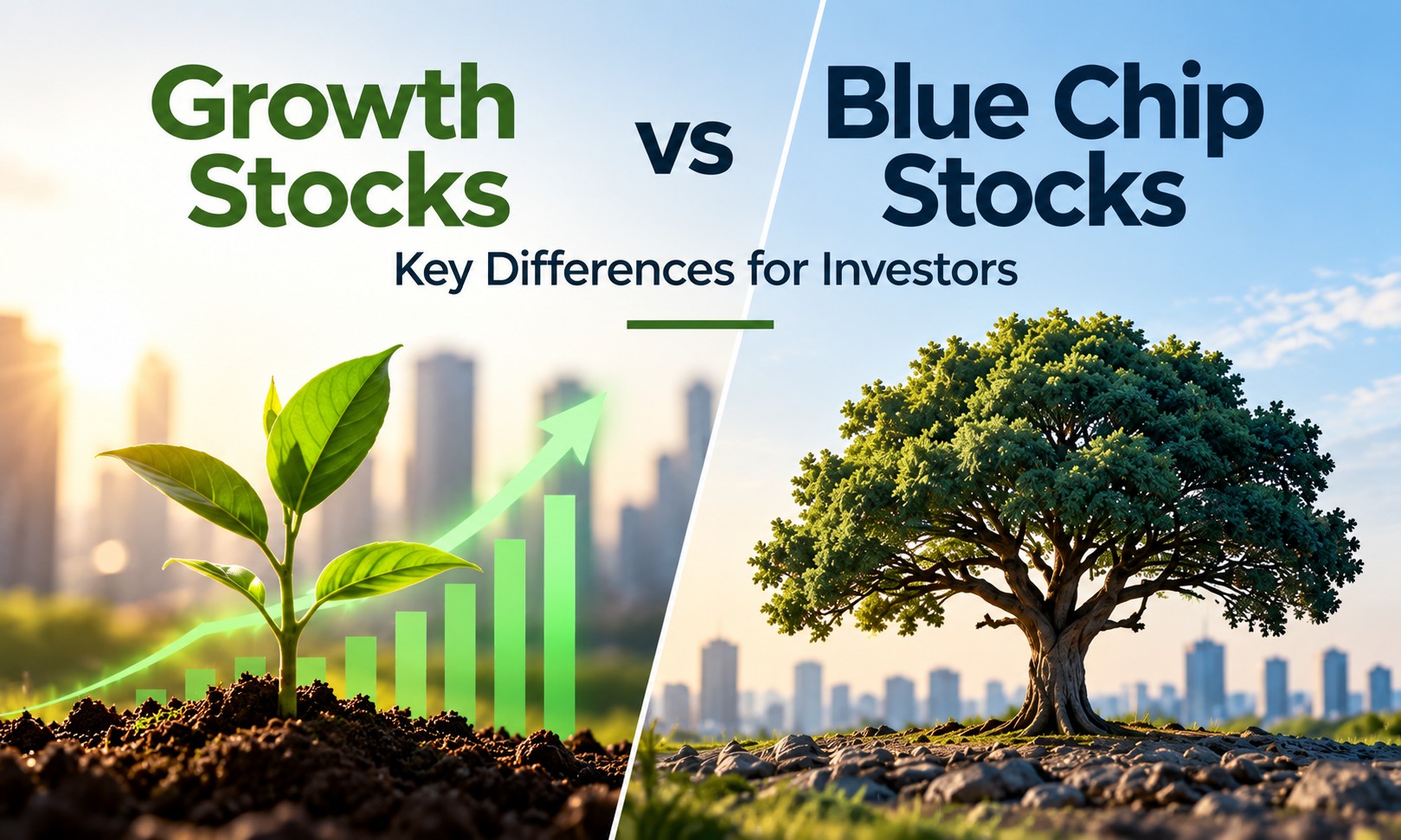
Investors may find it hard to decide among various types of shares, especially when some companies have scope for quick growth and other companies have already established themselves and have a longer track record. There are two broad categories of investments called growth stocks and blue-chip stocks.
Both have different qualities, possibilities and hazards. Australian investors can learn about growth stocks vs blue-chip stocks, so they can see how these investments might match with their financial objectives, investment period and tolerance for market changes. While growth stocks tend to be associated with expectations of growing earnings and business growth, blue-chip stocks are generally associated with established corporations that have large operations and recognised market positions. Neither group is inherently better than the other, and the correct choice depends on the company's fundamentals, valuation and an investor's personal circumstances.
What Are Growth Stocks?
Growth stocks are stocks of firms that investors predict to grow their revenue, earnings or market share faster than the overall market or industry. These enterprises may be involved in growing industries, bringing new products, penetrating new markets or benefiting from changes in the needs of consumers and business. Some growing firms reinvest most of their profits on research, technology, infrastructure or expansion rather than paying out huge dividends to shareholders.
Because much of their expected value might be tied to future corporate success, growth stocks are vulnerable to changes in market expectations. If investors feel a company can earn significantly more in the future, they may be ready to pay a higher price today. But the share price might plunge if growth stumbles, competition stiffens or financial targets are missed. Consequently, the prospects for a company’s growth should be considered with its profitability, cash flow, competitive position and current valuation, not solely on the basis of its industry or expansion ambitions.
What Are Blue-Chip Stocks?
Blue-chip stocks are often equities of large, well-established corporations with well-known brands, considerable operations and a history of doing business through a variety of economic conditions. They may have multiple sources of income, consumer relationships and somewhat mature company structures. Some also have a history of paying dividends, however there is never a guaranty of dividend payments and not all blue-chip companies will give a substantial income.
Blue chip stocks for Australian investors are often companies in established industries such as healthcare, finance, telecommunications, consumer goods and infrastructure. They can be somewhat easier to evaluate in terms of performance than an early-stage organisation due to their size and history of operations, but they are not immune to financial pressures or market instability. Changing consumer tastes, regulatory challenges, increased prices and competitive concerns might face established companies. Investors should not presume a well-known company is inherently a low-risk investment and should look at earnings projections, balance sheet, cash creation and valuation.
Growth Stocks vs Blue Chip Stocks: Key Differences
The primary distinction is the type of company opportunity investors are looking for. Growth stocks are frequently bought for their potential for growth in the future, while blue-chip stocks are often more established companies with a longer track record on their finances. Categories might overlap, for example a huge established company may still be growing at a high pace, but the distinction helps clarify the many variables investors generally look at.
Earnings and business maturity: Growth firms could still be expanding their business or creating new sources of revenue, so their future performance may be less predictable. Blue-chip companies tend to have more established streams of revenue, but earnings might still fluctuate depending on economic and industry conditions.
Dividends and income: Some growth companies keep earnings to fuel growth, which may limit dividend payments. Many blue-chip firms already make a profit and pay some of that profit to shareholders. How much they pay, and how regularly, depends on the company and its policies and profitability.
Valuation and expectations: Investors may be willing to pay a premium for growth stocks if they foresee large growth in the future. This can mean less potential disappointment when results are not as expected. Even blue-chip stocks can go pricey if the market has high expectations, therefore the size of the company does not decide alone if a stock is attractively priced.
- Risk and volatility: Growth stocks may have more volatile prices when expectations shift or funding becomes more challenging. Blue-chip stocks may have a more predictable operating performance sometimes but they still carry market, business and valuation risks. Neither type provides capital protection.

Which Type of Stock May Suit Different Investors?
Growth stocks might be appealing to investors with a longer investment horizon who can accept uncertainty and are comfortable evaluating companies whose future earnings are still unfolding. They may be prepared to tolerate bouts of higher volatility in return for the prospect of corporate growth. But quicker growth doesn’t mean better returns on investment.
Blue-chip stocks may appeal to investors who favour companies with established operations, a longer financial history, or the ability to provide dividend income. They can also be seen as part of a wider portfolio which is intended to balance different investment characteristics. However, investors should not use blue-chip stocks as a substitute for cash or expect them to not fall in value when the market takes a tumble. The best choice relies on your financial objectives, your need for income, your time horizon and your ability to stomach losses.
Can Investors Hold Both Growth and Blue-Chip Stocks?
There’s no reason why growth stocks and blue-chip companies can’t be competitive options. Some investors have a mix of both, to gain exposure to growing company opportunities while holding interests in more established companies. It is contingent upon your circumstances and simply owning shares in both groups doesn’t guaranty diversity.
Investors need to think about the businesses, industries and dangers embedded in their portfolios. Several growth stocks can be hit by the same economic trend, while a lot of blue-chip holdings can be focused in one area. By analysing asset allocation, each company’s valuation, and the correlation between holdings, you may gain a better sense of the total risk in your portfolio. Diversification by industry and asset type may help mitigate exposure to a single company or market area, but it cannot prevent losses.
Risk Considerations
Growth stocks can be sensitive to changes in expectations, uncertain earnings, competition and high valuations. Blue-chip stocks, despite their established position, may still face slower growth, industry upheaval, regulatory pressure and decreases in market value. Dividend payments are never guaranteed, and a company’s reputation or size is no guaranty of big profits in the future. Investors should analyse the financial health, business prospects, and valuation of each firm before making any investment decisions. The difference between growth and blue-chip companies is useful initially, but investment selections should eventually reflect personal objectives, investment time frame and tolerance for risk.
Disclaimer:
General Financial Product Advice and Regulatory Framework: Pristine Gaze Pty Ltd (ABN 66 680 815 678, ACN 680 815 678) operates as Corporate Authorised Representative (CAR No. 001312049) of Alpha Securities Pty Ltd (AFSL 330757), which is licensed and regulated by the Australian Securities and Investments Commission under the Corporations Act 2001 (Cth). This report contains general financial product advice only and has been prepared without consideration of your personal objectives, financial situation, specific needs, circumstances, or investment experience. The information is not tailored to individual circumstances and may not be suitable for your particular situation. Before acting on any information contained herein, you should carefully consider its appropriateness having regard to your personal objectives, financial situation, and needs, and consider seeking personal financial advice from a qualified financial adviser who can assess your individual circumstances and provide tailored recommendations.
Investment Risks and Market Warnings: All investments carry significant risk, and different investment strategies may carry varying levels of risk exposure including total loss of invested capital. The value of investments and income derived from them can fluctuate significantly due to market conditions, economic factors, company-specific events, regulatory changes, commodity price volatility, currency fluctuations, interest rate movements, and other factors beyond our control. Securities markets are subject to market risk from general economic conditions and investor sentiment, liquidity risk affecting the ability to buy or sell securities at desired prices, credit risk from issuer default or deterioration, operational risk from inadequate internal processes, sector-specific risks including industry regulatory changes, technology obsolescence, management changes, competitive pressures, supply chain disruptions, and mining-specific risks including resource estimation uncertainty, operational hazards, environmental compliance, permitting delays, commodity price cycles, geopolitical factors affecting mining operations, and exploration risks. Small-cap and speculative mining stocks carry additional risks including limited liquidity, higher volatility, dependence on key personnel, limited operating history, uncertain cash flows, and potential failure to achieve commercial production.
Information Accuracy and Limitations: While we endeavour to ensure information accuracy and reliability, we make no representations or warranties (express or implied) regarding the accuracy, reliability, completeness, timeliness, or suitability of information provided, except where liability cannot be excluded under applicable law. This report may include information from third-party sources including company announcements, regulatory filings, research reports, market data providers, financial news services, and publicly available information, which we do not independently verify and for which we assume no responsibility. Past performance, examples, historical data, or projections are not indicative of future results, and no guarantee of future returns is provided or implied. To the maximum extent permitted by law, Pristine Gaze Pty Ltd and Alpha Securities Pty Ltd, together with their respective directors, officers, employees, representatives, and related entities, exclude all liability for any errors, omissions, inaccuracies, loss or damage (including direct, indirect, consequential, or special damages) arising from reliance on information provided, investment decisions made based on this report, market losses, opportunity costs, and technical issues or system failures.
Frequently Asked Questions
Common questions about investing and market research to help guide your decisions.